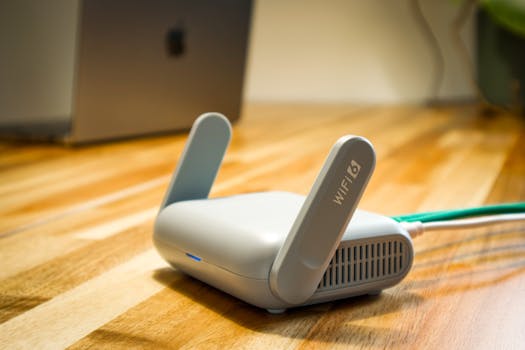
Everything You Need to Know About the Difference Between WiFi 7 and Upcoming WiFi 8 Standards for Future Proofing Your Home Network
Let's face it: our digital lives are constantly evolving. From streaming 8K movies to diving headfirst into virtual reality, our home networks are working harder than ever. Keeping up can feel like a full-time job. With new Wi-Fi standards popping up every few years, it's easy to get lost in the alphabet soup of acronyms and numbers.
Right now, WiFi 7 is the new kid on the block, bringing some seriously impressive upgrades. But whispers about WiFi 8 are already making the rounds. So, what's the real difference, and more importantly, how do you make sure your home network is ready for whatever comes next without breaking the bank? Let's get straight to it.
The Current Contender: Understanding WiFi 7 (802.11be)
WiFi 7, officially known as 802.11be or "Extremely High Throughput (EHT)," is a game-changer that's already hitting the shelves. It’s designed to handle the most demanding applications we can throw at it today, and then some. Think of it as opening up a superhighway for your data.
This standard builds on the tri-band capabilities of WiFi 6E, utilizing the 2.4 GHz, 5 GHz, and the spacious 6 GHz bands. But it doesn't just use them; it supercharges them.
Here are some of the key innovations that make WiFi 7 truly stand out:
- Wider 320 MHz Channels: Imagine an eight-lane highway suddenly expanding to a 16-lane superhighway. WiFi 7 doubles the channel width in the 6 GHz band compared to WiFi 6E, allowing for vastly more data to flow simultaneously. This means significantly higher speeds and less congestion.
- 4096-QAM (Quadrature Amplitude Modulation): This is where things get really technical, but the upshot is simple: more data packed into each signal. While WiFi 6 uses 1024-QAM, WiFi 7 steps it up to 4096-QAM. It’s like upgrading from standard definition to ultra-high definition for your data packets, fitting more information into the same space.
- Multi-Link Operation (MLO): This is arguably one of WiFi 7's coolest tricks. MLO allows devices to simultaneously send and receive data across different frequency bands (2.4, 5, and 6 GHz). Instead of picking just one lane, your device can use multiple lanes at once, leading to lower latency and incredible reliability. If one band gets jammed, the data seamlessly switches to another.
- Preamble Puncturing: Sometimes, parts of a wide channel might be in use by another device. Previous Wi-Fi versions would just avoid the entire channel. WiFi 7, with preamble puncturing, can "puncture" out those occupied segments and use the rest of the channel efficiently. It’s about making the most of every bit of available spectrum.
With these advancements, WiFi 7 is tailor-made for applications like high-fidelity AR/VR, multiple concurrent 8K video streams, and environments packed with smart home devices. If you're running a busy digital household, WiFi 7 offers a compelling upgrade right now.
Gazing into the Crystal Ball: What We Know About Upcoming WiFi 8 (802.11bn)
Now, let's talk about the future, specifically the one that's still largely on the drawing board. When we mention "WiFi 8," we're talking about the standard that will eventually succeed WiFi 7. While it doesn't have an official catchy name like "WiFi 8" just yet – the IEEE often refers to it by its project name, likely 802.11bn, or an even more advanced "Extremely High Throughput" phase – the industry is already anticipating its arrival.
We’re still a few years out, but the general direction is clear: even more speed, even greater efficiency, and even lower latency. Think of WiFi 8 as pushing the boundaries of what’s possible with wireless connectivity.
What might WiFi 8 bring to the table?
- Terabit Speeds: While WiFi 7 pushes into multi-gigabit speeds, WiFi 8 is expected to aim for *terabit-per-second* throughput. That's a mind-boggling amount of data, enough to download an entire high-definition movie in mere seconds.
- Enhanced Efficiency and Capacity: Our homes are only getting smarter, with more devices clamoring for bandwidth. WiFi 8 will likely introduce even more sophisticated techniques to manage thousands of devices simultaneously, ensuring smooth performance even in the most crowded networks.
- Ultra-Low Latency: For the next generation of real-time applications, like true holographic communication, advanced cloud gaming, or industrial automation, latency needs to be virtually zero. WiFi 8 will certainly push this frontier further than ever before.
- New Spectrum Utilization: As the airwaves get more crowded, future Wi-Fi standards will need to explore new frequency bands beyond the current 2.4, 5, and 6 GHz. While speculative, WiFi 8 could potentially tap into even higher frequencies, like the millimeter-wave bands, to unlock unprecedented bandwidth.
- AI and Machine Learning Integration: This is where things get really interesting. Imagine a network that can intelligently predict traffic patterns, dynamically allocate resources, and even self-diagnose and fix issues. WiFi 8 might deeply integrate AI and ML to optimize network performance on the fly, making it smarter and more adaptive.
WiFi 8 is essentially the groundwork for applications and experiences we can barely imagine today. It's not just about faster internet; it's about enabling a truly interconnected, responsive, and intelligent digital environment.
The Core Differences: WiFi 7 vs. Upcoming WiFi 8
So, you've got the lowdown on both. Now, let's lay out the key distinctions between what's available today and what's brewing for tomorrow. Understanding these differences is crucial for any smart investment decisions.
The progression from WiFi 7 to WiFi 8 isn't just an incremental step; it's a significant leap in ambition and capability.
Here’s a snapshot of how they stack up:
- Speed & Throughput: WiFi 7 offers multi-gigabit speeds, pushing up to tens of gigabits per second in ideal conditions. WiFi 8, however, is being designed with *terabit* speeds in mind. That's an order of magnitude increase, signaling a massive jump in raw data transfer capability.
- Efficiency & Capacity: Both standards focus on handling more devices. WiFi 7 introduces MLO and wider channels for better spectral efficiency. WiFi 8 will build upon these, likely with even more advanced spatial multiplexing, interference mitigation, and potentially smarter antenna technologies to serve an even greater number of devices with more demanding profiles.
- Latency: WiFi 7 significantly lowers latency, crucial for AR/VR. WiFi 8 is expected to drive latency down to near-imperceptible levels, enabling truly real-time, interactive experiences without any noticeable delay.
- Technological Foundation: WiFi 7 introduces foundational technologies like MLO and 4096-QAM. WiFi 8 will either enhance these further or introduce entirely new paradigms. Think of it as MLO being a major innovation for 7, but 8 might have its own groundbreaking equivalent that radically changes how data is transmitted.
- Maturity & Availability: This is the biggest practical difference. WiFi 7-compatible devices (routers, client devices) are available now and more are coming. WiFi 8, on the other hand, is still in its research and development phases. We're looking at several years, potentially 2028 or even later, before we see widespread adoption.
In essence, WiFi 7 is about maximizing current spectrum and existing technologies to their fullest potential, delivering a powerful punch for today's high-demand tasks. WiFi 8 is about envisioning and creating the technological backbone for an entirely new generation of digital experiences.
Future-Proofing Your Home Network: Practical Advice
The million-dollar question, right? With these new standards on the horizon, how do you make smart choices today to avoid feeling obsolete tomorrow? The truth is, "future-proofing" is less about predicting the exact future and more about making flexible, intelligent investments.
Here’s some no-nonsense advice for navigating the Wi-Fi evolution:
- Don't Wait for WiFi 8: If you have demanding internet needs—think heavy gaming, 8K streaming, or multiple users on a fast fiber connection—waiting for WiFi 8 is simply not practical. It's too far off. WiFi 7 offers a massive upgrade over older standards and is robust enough for anything you'll likely do in the next several years.
- Assess Your Current Needs and Devices: Do you actually *need* WiFi 7 speeds? If your internet service provider (ISP) only offers 500 Mbps, or most of your devices only support WiFi 5 or 6, a WiFi 7 router might be overkill for now. However, if you have a multi-gigabit internet connection (2.5 Gbps, 5 Gbps, or even 10 Gbps fiber) and new devices, a WiFi 7 router is a strong contender.
- Invest in a Good Router Now (if applicable): If you do decide to upgrade, look for a reputable WiFi 7 router from a known brand. Many modern WiFi 7 routers also come with multi-gigabit Ethernet ports, ensuring your wired connections are also up to snuff. This adds another layer of "future-proofing" for your network backbone.
- Consider Your Internet Plan: Your Wi-Fi is only as fast as the internet coming into your home. If you're still on a basic DSL or cable plan, upgrading your Wi-Fi standard won't magically make your internet faster. A fast fiber connection is key to truly leveraging what WiFi 7 (and eventually WiFi 8) has to offer.
- Look for Mesh Systems: For larger homes, a mesh Wi-Fi system can be a smarter long-term investment than a single powerful router. Many WiFi 7 mesh systems are available, providing excellent coverage and expandability. This allows you to add more nodes as your home or needs grow, often integrating seamlessly.
- Don't Chase Every Bleeding Edge: For the average user, the jump from WiFi 5 to WiFi 6 was noticeable. From WiFi 6 to 7 is significant for high-demand users. But not every user needs the absolute latest. Sometimes, a solid WiFi 6 or 6E system perfectly meets your needs without the premium price tag of the newest standard.
The key here is balance. Understand your actual usage, your internet connection, and the devices you own. Then, make a choice that aligns with those realities, rather than getting caught up in the hype.
The Takeaway: Navigating the WiFi Evolution
The world of Wi-Fi is constantly moving forward, bringing faster speeds, lower latency, and greater efficiency with each new generation. WiFi 7 is a truly impressive leap, ready to handle the demanding digital experiences we're already embracing, from immersive VR to the explosion of smart home devices. It’s here, it's powerful, and for many, it’s a perfectly sensible upgrade for today and the near future.
WiFi 8, on the other hand, is the next horizon. It represents a visionary push towards terabit speeds, ultra-low latency, and intelligent network management that will unlock entirely new possibilities for connectivity. However, it's still several years away from widespread adoption. Holding out for it now would mean missing out on significant improvements available today.
For those looking to future-proof their home network, the smart move often lies in making incremental, informed upgrades based on current needs and available technology. Investing in a solid WiFi 7 setup now, especially if you have a fast internet connection and compatible devices, is a sensible way to stay ahead of the curve. When WiFi 8 finally arrives, your well-planned network will be ready for its next logical evolution, rather than a frantic scramble.